Using The Brand Tree to Understand Branding

The brand tree is a framework that maps a brand as a living tree. The roots are purpose, personality, promise and pledge. The trunk is positioning, proof, pursuit and practice. The branches, leaves and flowers are the visible execution: partnerships, promotion and proactivity, where the logo and visual identity live.
Updated November 2026
Far too often, logos are mistaken for the whole of a brand. This isn't just a mistake made by people outside of the marketing and creative industries, either.
The truth is that a brand is much more than a logo. A brand is something that grows, changes, and evolves. The logo is merely a flower, and the brand an entire living tree.
Like a business, this tree could be hundreds of years in the works, but its species (industry), environment (market), and natural existence (ways of working) help it stand out. Each of these things helps to differentiate it within the forest, where some thrive and grow while others simply die without the world noticing.
A brand, like a tree, has roots, a trunk, branches, and leaves.
It all begins with an emotional foundation: the roots.
The roots of the brand tree consist of purpose, promise, pledge, and personality.

These foundational brand elements are the base from which the brand grows. If the roots are poor or incomplete, the brand will be as well. For example, if a brand launches without a purpose, its trunk and its branches will never grow strong.
A business must carefully plant and nurture its brand roots until it grows into something observable, noticeable, memorable.
Remembering one's roots is why the creation story is so powerful in the branding process. Whether a business was founded in a dorm room, or a garage, or part of a big corporate merger, it says a lot about who the brand is on a personal level.
PURPOSE
The purpose of a brand is where it all begins. Everything begins with why. Purpose gives the rest of the brand something to organize around. If the team can't explain why the business exists beyond what it sells, positioning, messaging, and identity are much more likely to drift.
PERSONALITY
Personality is the next major part of a brand's foundation. It is who they are and how they exist in the world. Along with the purpose, it is the emotional, truthful representation of a business that lets it truly live. Would Geico be Geico without embracing their light-hearted and witty personality through the TV and radio commercials we all know? That is a core part of who they are as a brand; an identity we can all recognize.
A clear personality gives people a consistent sense of how the brand sounds, behaves, and responds. That consistency makes the brand easier to recognize across every interaction.
PROMISE
A brand's promise is another important aspect of its root system. The promise of a brand comes to life in the emotion they offer their consumer. Geico elicits some laughs with its witty personality, but it promises a feeling of connection and trust. A Geico customer knows that even though their insurance company may joke around, they are a brand that they can rely on for both affordable rates and dependability. That is their promise.
PLEDGE
The fourth and final segment of a brand's root system is their pledge, which consists of the tangible values that they are dedicated to. The pet health company Earth Animal pledges to never use ingredients that are not naturally sourced. This pledge consists of a value that is connected to the brand's purpose, personality, and promise, but remains its own segment of the brand.
The second part of the brand tree is the functional brand extension: the trunk.
The trunk is the extension of the roots that supports it as it grows.
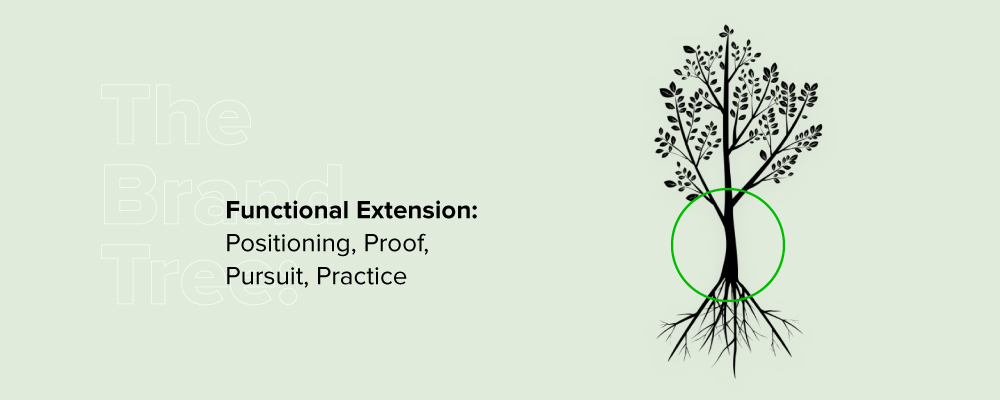
The trunk of a brand consists of positioning, proof, pursuit, and practice.
POSITIONING
Positioning is how a brand defines its place in the market: who it is for, what makes it different, and why someone should choose it. Unlike the roots, positioning can shift as the market, competition, or customer changes.
Going back to our Geico example, it is important to note that Geico wasn't always light-hearted and chuckle-inducing. Originally, Geico was a much more stuffy, less-fun Government Employee Insurance Company. Around 1994, they essentially replanted themselves to better fit their environment and competition by partnering with The Martin Agency (more on partnerships below). Like the trunk of the tree growing around or through an obstacle, a brand can shift its positioning to thrive.
PROOF
A brand's proof is how a brand confirms their position and demonstrates their values in the world. For example, Gillette shifted its position in 2019 from a macho man's brand to a brand for socially-conscious men. They confirmed that position through their controversial ad, The Best a Man Can Be. That is the brand's proof of position, always growing along one another.
PURSUIT
The pursuit of a brand is the constant reach the brand exhibits toward a goal they are in the process of achieving. Any good brand will always be in the middle of striving towards something, whether that be a new customer segment or world peace.
PRACTICE
The fourth component of the trunk is practice. A brand's practice is essentially how they operate: their methods, processes, and things they do repeatedly. For the Connecticut Art Directors Club, hosting an annual awards show for the creative community is one example of a recurring brand practice. Another practice might be individuals of a brand always starting their days with a team huddle, or taking a group coffee break every Tuesday at 2pm.
Just like the other three components of the trunk, a brand's practice is always growing and changing as the brand's values and position change.
The third and final part of the Brand Tree are the leaves, branches, and flowers, which represent the executional parts of a brand: partnerships, promotion, and proactivity.
This is where the visual branding lives.
The logo, the corresponding visual elements, the billboards, the menus, the letterheads, and the coffee mugs. It is the segment of the brand that is most visible and appealing, which is the reason so many people mistake it for the whole brand.

The executional side of a brand is focused on how the brand looks and how it is perceived. There is a reason why a brand needs beautiful flowers and leaves to properly present itself to the world and catch attention, but there would be no flowers or leaves without the supporting trunk and strong roots.
PARTNERSHIPS
Partnerships are the people, organizations, and communities a brand chooses to align with. Red Bull is an obvious example: sponsorships and partnerships have helped extend the brand far beyond the can and into sports, events, and culture.
PROMOTION
A brand's promotion is where the logo lies that we all worship and praise (finally!). It is far too often that we see start-up companies come to us for a logo. It's important to hit the pause button here, get them into a room, and discuss the roots and trunk of their business before ever considering what a logo might look like.
That same thinking shapes Digital Surgeons' Brand Sprint: establish the strategic foundation first, then build the identity system from it. Once the positioning, audience, and voice are clear, the visual work has something real to express.
Once the foundation is clear, the visual identity can extend consistently across packaging, digital experiences, campaigns, and products. Those expressions should evolve as customers, culture, and technology change without losing the strategy underneath them.
PROACTIVITY
A brand's proactivity is how it acts ahead of events and trends instead of reacting to them. Proactive brands watch where their customers, their culture and technology are heading, and move first: they launch the product, take the stance or start the conversation before anyone asks. It keeps the branches growing toward the light.
How to use the Brand Tree on your own brand
If you're using the Brand Tree to evaluate your own brand, start with the layer where the disconnect appears. If the visuals suddenly feel wrong, ask whether the problem is really the identity or whether the positioning, promise, or practices underneath it have changed. A rebrand works better when you fix the layer causing the problem instead of automatically starting with the logo.
A brand is a living thing. It grows and adapts. And if you remember one thing from the Brand Tree, make it this: a brand is not a logo.
Frequently Asked Questions
What is the brand tree in branding?
A framework that describes a brand as a tree with three layers: roots (purpose, personality, promise, pledge), trunk (positioning, proof, pursuit, practice) and branches, leaves and flowers (partnerships, promotion, proactivity). Each layer depends on the one beneath it.
What are the roots of a brand?
Purpose (why the business exists), personality (how it behaves and sounds), promise (the feeling it offers customers) and pledge (the tangible values it commits to).
What is the trunk of a brand?
The functional layer that carries the roots into the market: positioning, proof that backs the position, the pursuit the brand is working toward, and the practices it repeats.
Where does the logo fit in the brand tree?
In the flowers and leaves, under promotion. It is the most visible part of the brand and depends on the roots and trunk to mean anything.
How do you use the brand tree in a rebrand?
Work from the bottom up: confirm purpose, personality, promise and pledge, then positioning and proof, and only then design the identity. If you need to move from strategy into identity quickly, Digital Surgeons' Brand Sprint is a focused two-week engagement that works through positioning, audience, voice, and visual direction before building the identity system.