Google AI Mode Is Cutting Website Clicks. Here's What Business Owners Should Do Now

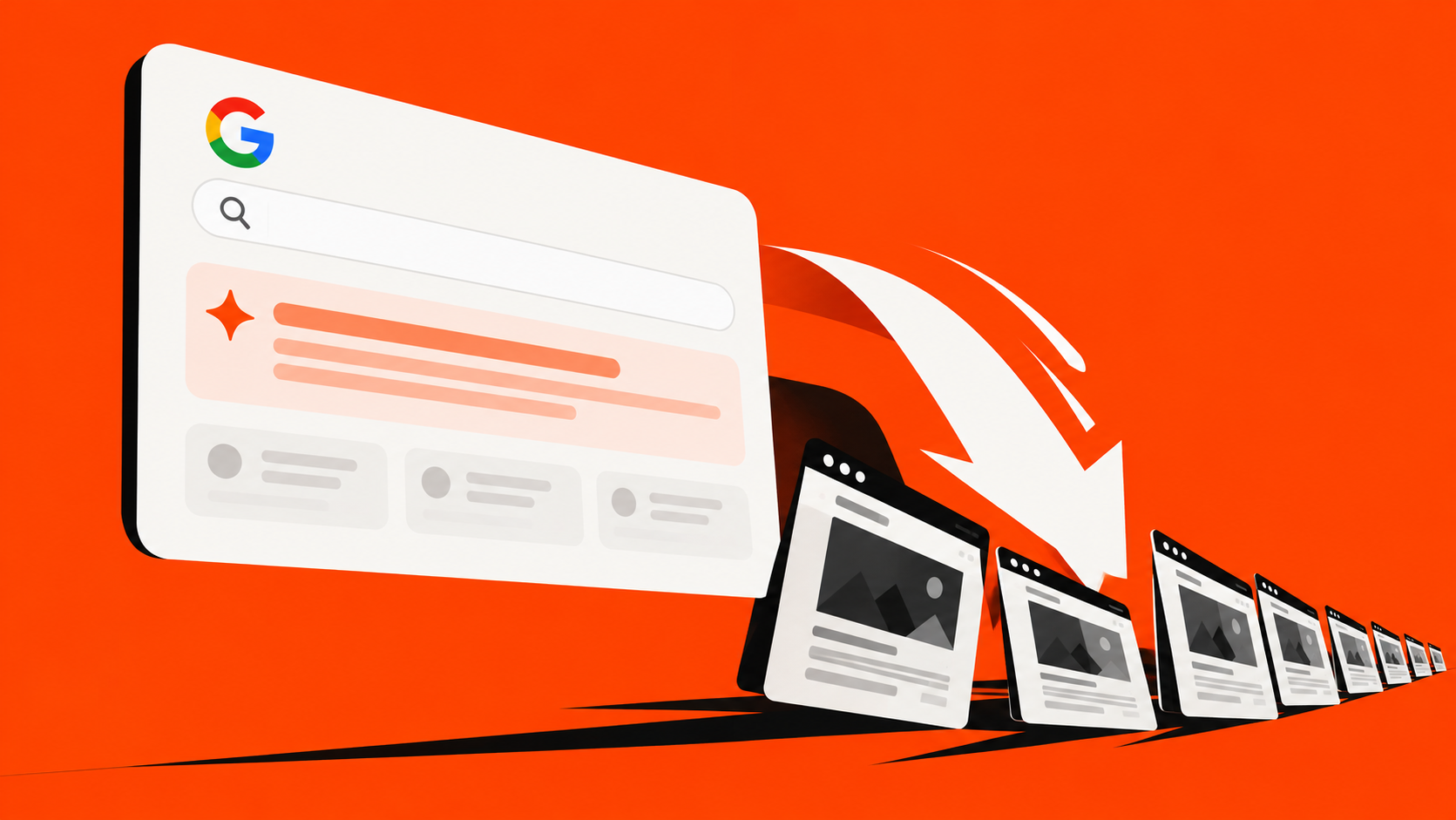
Google AI Mode is sending fewer people to business websites. A new randomized study found that when people were assigned to search through AI Mode for seven days, clicks to outside sites dropped by 18.8 percentage points. For businesses that rely on search traffic, it's one more reason to investigate where clicks are being lost and which kinds of queries still bring qualified visitors.
The good news: buyers didn't disappear. They're just getting answers before they reach you. The businesses that win now are the ones AI names, and the ones people search for by name.
Here's what happened, what it means, and the five moves to make this quarter.
What did the new Google AI Mode study find?
AI Mode cut clicks, cut satisfaction, and pushed people to rival search engines. Researchers tested 1,100 U.S. Chrome users in March 2026, and Search Engine Land reported the results on September 23, 2026. For one week, some people had every Google search pushed into AI Mode. Others used Google as normal.
The results were blunt:
- 18.8 points fewer clicks to outside websites
- 0.92 fewer Google search sessions per person, per day
- Lower satisfaction and lower trust in Google
- 11.2 points more people switched to Bing, DuckDuckGo, or Yahoo
One fair caveat: the study assigned AI Mode as the default for seven days, while real users choose when to use it. But at I/O in May 2026, Google said AI Mode had passed one billion monthly users worldwide and that queries had more than doubled each quarter since launch. Choice is turning into habit, fast. You can read the full research paper for the method.
Why does this matter for your business?
Ranking on page one no longer guarantees a visit. Google answers the question itself, and your website becomes a footnote.
This trend isn't new. It's just speeding up. SparkToro's analysis found that 68% of U.S. Google searches ended without a click in early 2026, up from 60% in 2024, though the two years' figures come from different data panels. Separately, Ahrefs found that when an AI Overview appears, click-through rates drop by about 58%.
Think about what that does to your numbers. If your pipeline depends on blog traffic turning into leads, the same rankings now produce fewer leads. Not because your content got worse. Because the click became optional.
What still works in search?
Searches where people already know what they want still send clicks. SparkToro co-founder Rand Fishkin points to three kinds that still pay off:
- Branded searches: people typing your company name
- Local searches: "near me" and city-based queries
- High-intent buying searches: "pricing," "agency for," "hire," "get a quote"
See the pattern? Each one depends on a buyer who already trusts you, is already near you, or is already ready to buy. Your job now is to create more of those moments.
5 moves business owners should make this quarter
1. Make your brand the thing people search for
When buyers remember your name, they can look for you directly instead of starting from a generic category search. For AI-assisted discovery, your positioning and publicly available proof also need to be clear enough to evaluate.
Ask yourself: can a stranger explain what you do, and why you're different, in one sentence? If not, AI can't either. Tighten your positioning first. Our guide on how B2B brands stop looking like everyone else is a good place to start, and our brand strategy team does this work every day.
2. Write pages AI can quote
AI engines pull short, confident, specific answers. Give them one.
- Open every key page with a one-sentence answer to the question it targets
- Use real numbers with a source and a date (for example, "cut onboarding time 32% in 2025")
- Add an FAQ section built from the exact questions customers ask on sales calls
- Use supported structured data, such as Organization markup, so machines can read who you are. It clarifies your information but doesn't guarantee AI mentions, and Google limited FAQ rich results back in 2023
- Put a real person's name and bio on your content
Vague copy like "we deliver innovative solutions" gives AI nothing to quote. Specific copy is far more likely to be cited.
3. Get mentioned where AI looks
AI answers are built from what the web says about you, not just from your own site. In the study, clicks to Reddit, Wikipedia, and news sites all fell. That's a sign AI is summarizing those sources instead of sending people to them.
So show up there:
- Earn reviews on Google, G2, Clutch, or your industry's top review site
- Answer real questions in relevant Reddit and LinkedIn threads, as a named expert
- Pitch your data and opinions to trade press and podcasts
- Keep your Google Business Profile complete and current
This is one of the branding trends that actually changed in 2026: your brand is now what the internet says about you, summarized by a machine.
4. Turn your website into a closer, not a library
Fewer visitors means every visitor counts more. People who click through an AI answer arrive further along. They've already compared options. Now they're checking you out.
Give them what they need to say yes:
- Proof above the fold: client logos, results, case studies
- Clear pricing signals or "starting at" ranges
- One obvious next step on every page
- Fast load times on mobile
If your site was built to collect traffic instead of convert it, it's time for a website built to convert.
5. Measure what clicks can't show
If you judge marketing by organic sessions alone, AI Mode will make you look like you're losing even when you're winning. Track these instead:
- Branded search impressions in Google Search Console
- AI referral traffic (chatgpt.com, perplexity.ai, gemini.google.com) in GA4
- Lead quality, not just lead count
- A "How did you hear about us?" field on every form
Then put budget where demand is actually forming. That's what full-funnel marketing looks like now.
The bottom line
Google AI Mode isn't killing demand. It's moving the moment of choice onto the search page. The brands that show up in that answer, and the brands buyers search for right after, will take the share everyone else loses.
If search visibility is changing but you can't tell where qualified inquiries are coming from, let's look at your positioning, website and measurement together. Talk to our team about what needs to change first.
Frequently asked questions
What is Google AI Mode?
Google AI Mode is a chat-style search experience that answers questions with an AI-written response and a small set of links. Google said at I/O 2026 that it had passed 1 billion monthly users.
Does Google AI Mode reduce website traffic?
Yes. In a randomized experiment with 1,100 U.S. users, searches in AI Mode led to an outside website 18.8 percentage points less often than normal Google searches.
Is SEO dead because of AI Mode?
No. SEO still drives results for branded searches, local searches, and high-intent buying searches. What changed is that ranking alone no longer guarantees a click, so brand demand and AI citations matter more.
How do I get my business cited in AI answers?
There's no guaranteed method, but these help: put a clear, one-sentence answer at the top of each key page, back claims with specific numbers and sources, add FAQ sections and supported structured data, and earn mentions on the sites AI pulls from, such as review platforms, Reddit, industry press, and LinkedIn.
How should I measure success if clicks are falling?
Track branded search volume in Google Search Console, AI referral traffic in GA4, lead quality, and a 'How did you hear about us?' field on every form. These show demand that click-through rate alone misses.
Want to be the brand AI recommends? Book your Brand Sprint intro call →