A Brand Strategy Framework That Your Team Can Actually Use

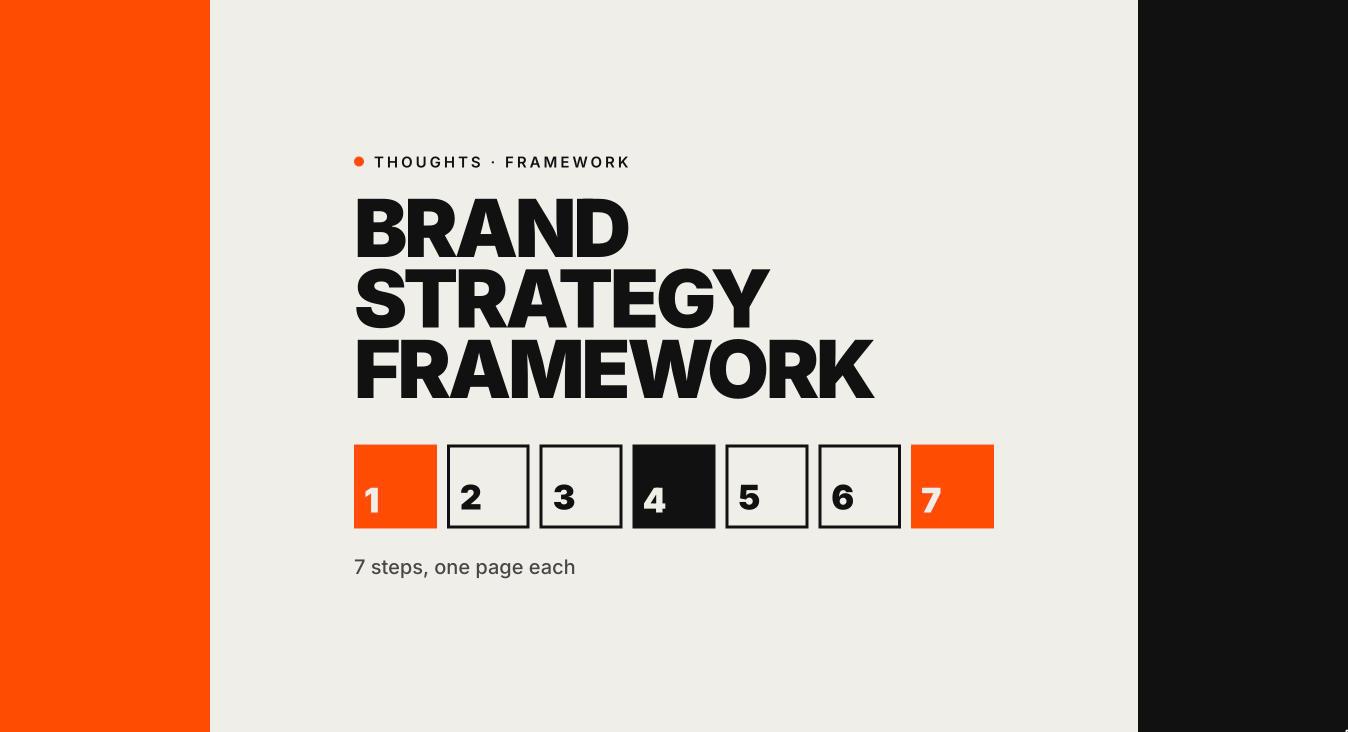
Short answer: A brand strategy framework is a sequence of decisions that gives the work direction: who you serve, where you win, what you promise, how you sound, what you say, how your offers fit together, and how you'll know it's working. The seven steps below each end in a one-page output your team can use.
Updated November 2026. Written by the Digital Surgeons team.
A lot of brand strategy ends up in a deck nobody uses. Other teams jump straight to a new logo before agreeing on the story it's supposed to tell. A framework fixes both. It forces the hard choices in the right order, and it leaves you with short, practical tools your team can work from.
This is the framework we use with clients at Digital Surgeons, from AI startups to energy companies. Use it on your own, or use it to judge whether an agency's process covers the basics.
Step 1: Define the business problem
Start with what the brand has to do for the business in the next 12 to 24 months. Raise a round? Move upmarket? Explain a new product line? Recover from a merger? A brand strategy with no business goal turns into a style exercise.
Output: one sentence. "Our brand needs to help us [business goal] by [date], and today it's getting in the way because [problem]."
Step 2: Know exactly who you're for
Name the people who buy, use and influence the purchase. In B2B that's usually a committee: an economic buyer, a technical evaluator, an end user. Talk to real customers, lost deals, sales and the people closest to the customer. Look for the language that keeps showing up, especially where it differs from the language the company uses internally.
Output: a short profile for each audience: the problem they're trying to solve, what gets in the way, what they need to believe before they buy, and the exact phrases they used in interviews.
Step 3: Choose where you win (positioning)
Positioning is deciding what you want to be chosen for, by whom, and what you need to be meaningfully different from. You don't need to win every comparison. You need to be the clear choice for the right one.
Output: a positioning statement.
For [audience] who [need or problem], [brand] is the [category or frame of reference] that [key benefit], because [proof or reason to believe]. Unlike [main alternative], we [key difference].
For B2B companies, our guide to B2B brand positioning goes deeper.
Step 4: Define the promise and the values behind it
The brand promise is what customers can count on every time. Values are the beliefs that make the promise credible inside the company. We map these with the Brand Tree. The roots hold purpose, promise, pledge (your values) and personality; the trunk holds positioning and the proof behind it; the branches are where visual identity, partnerships and promotion live. If the roots are weak, everything above them wobbles.
Output: a one-line promise and three to five values, each with a sentence on how it shows up in behavior.
Step 5: Set the personality and voice
Personality is how the brand would behave if it were a person. Voice is how that personality writes and speaks. Define both with contrasts, so people know where the line is.
Output: three to four voice traits written as "this, not that": confident, not arrogant; plain-spoken, not casual; optimistic, not hype. Add two example sentences for each.
Step 6: Build the messaging architecture
Turn the positioning into the things your team actually says. A messaging architecture has one core message, three or four supporting pillars, and proof points under each pillar: data, case studies, customer quotes.
Output: a one-page message house. Here's how one might look for an energy company:
- Core message (the one idea every touchpoint reinforces): Clean power that the grid can count on.
- Pillars (3 to 4 reasons to believe): Reliability, speed to deploy, proven economics.
- Proof points (data, case studies and quotes for each pillar): Deals closed, uptime figures, customer results.
- By audience (how each pillar is framed for each buyer): For the CFO, cost certainty. For operations, uptime.
When we rebuilt the brand for Equilibrium Energy, the clearer positioning and messaging helped sales explain the value faster and pre-qualify prospects earlier. Within weeks of launch, the company closed three major deals and saved an estimated 20+ hours of sales meetings a month.
Step 7: Organize the brand architecture and measure it
Brand architecture decides how your company brand, products and sub-brands relate: one master brand, endorsed brands, or a house of brands. Then decide how you'll know the strategy is working.
Output: a simple architecture diagram and three to five measures, for example: share of branded search, sales-cycle length, win rate against your main competitor, how often AI assistants describe you the way you want, and employee understanding of the positioning.
Putting the framework to work
The framework only matters if the people doing the work can use it. Turn it into a visual and verbal identity, a website that tells the story in the first scroll, sales materials built on the message house, and guidelines your team and its AI tools can follow. Revisit it every year, or whenever the business changes direction.
Five mistakes that sink a brand strategy
- Starting with the logo. Identity should express a strategy, and it can't stand in for one.
- Positioning for everyone. If your statement would fit three competitors, it isn't positioning yet.
- Skipping real customer research. Internal opinions are where strategy starts, and customers are where it gets tested.
- Writing it for the board instead of the team. If sales can't use it on a call tomorrow, simplify it.
- Never measuring it. Pick a few measures before launch so you can tell whether the strategy is working.
Frequently asked questions
What is a brand strategy framework?
A brand strategy framework is a step-by-step structure for defining a brand: the business goal, the audience, the positioning, the promise and values, the personality and voice, the messaging, and the brand architecture. Each step produces a short tool the team can use.
What are the key components of a brand strategy?
The core components are a clear business goal, a defined audience, a positioning statement, a brand promise and values, a personality and voice, a messaging architecture, brand architecture, and a way to measure results.
How long does it take to build a brand strategy?
A focused team can build the core of a brand strategy in a few weeks. Digital Surgeons' Brand Sprint delivers strategy, an identity system and launch-ready visuals, starting from 2 weeks. Large companies with several audiences, markets or sub-brands usually need a few months.
What's the difference between brand strategy and marketing strategy?
Brand strategy defines who you are, who you're for and why you're different. It changes rarely. Marketing strategy decides how you'll reach and convert people this quarter or this year. Good marketing strategy is built on top of the brand strategy.
Can I build a brand strategy without an agency?
Yes, especially at an early stage: use the framework above, talk to customers, and keep each output to one page. An agency is worth it when the stakes are high (a raise, a merger, a move upmarket) or when internal teams can't agree. See our comparison of the best brand strategy agencies.
Want a brand strategy your team can actually use?
If the business has evolved but the way you explain it hasn't, our brand strategy team can help get the story, positioning and identity caught up. If you're on a deadline, the Brand Sprint gets there in about two weeks. Talk to our team.