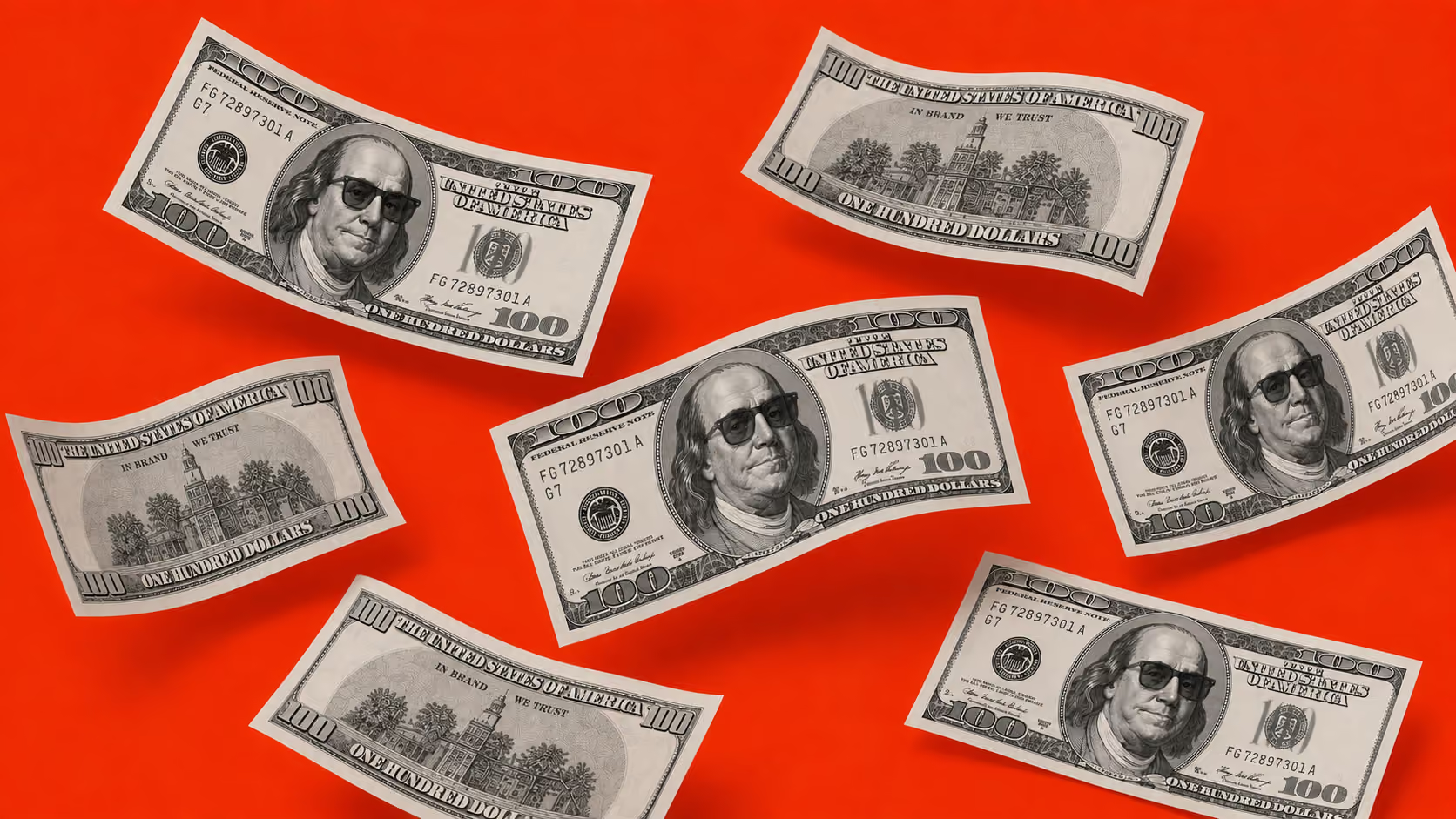
Brand Is Capital: Why What You Look Like Determines How Much You Raise

Quick Answer: Why does brand matter when raising capital?
A strong startup brand can make fundraising easier by increasing investor confidence, communicating a clear point of view, and differentiating a company from competitors. Brand does not replace strong financials, product-market fit, or execution, but it shapes how investors perceive the company's potential, credibility, and risk before they fully evaluate the numbers. For founders raising capital, a clear narrative, distinctive positioning, and consistent visual identity can help turn initial attention into investor interest.
In a market where capital concentrates into fewer deals than ever, your brand is the first filter you either pass or don't.
The fundraising conversation most founders believe in goes like this: the numbers speak for themselves. The deck is tight, the model is solid, the TAM is real. The brand, they think, is a vanity play something you do after the round closes.
That belief is costing them money. And the data is starting to prove it.
The Market You're Raising Into
Before we talk about brand, let's be clear about the environment.
Venture and growth investors poured $425 billion into more than 24,000 private companies in 2025 up 30% year over year, making it the third-highest venture financing year on record. But the headline hides the real story: more capital is being invested overall, yet investments are concentrated into a smaller number of startups. The average deal size has continued to grow compared to pre-pandemic levels, with early-stage deals now 2x larger and later-stage deals nearly 3x larger. Crunchbase NewsPilot
Translation: the money is there. The bar to get it has never been higher.
The median seed valuation in Q1 2025 reached $16 million above the $14 million peak of early 2022, and twice the $8 million median at the start of 2020. In plain terms: the bar for getting funded at seed has never been higher, and only the most convincing startups clear it. The VC Factory
In a market where capital concentrates into fewer hands, the companies that win are not necessarily the ones with the best spreadsheets. They're the ones that make investors feel, from the very first moment, that they're already looking at something that matters.
That feeling is what the brand produces.
Brand Is Not Decoration. It's a Valuation Multiplier.
This is no longer an opinion. It's a number.
According to Brand Finance's World's Most Valuable B2B Brands 2026 report, companies with stronger branded businesses command a 65% premium in forward price-to-earnings ratios meaning investors are willing to pay significantly more for every dollar of profit a strong brand generates. Extremely strong brands also achieve 45%+ higher EBIT multiples than lower-rated peers. Brand Finance
Lorenzo Coruzzi, Valuation Director at Brand Finance, put it plainly: "Brand in B2B is a critical element for winning in the market, although it has been systematically underinvested in as an asset. Stronger brands consistently translate into lower risk, greater investor confidence, and more resilient long-term value creation proving that brand is a measurable driver of financial performance." Brand Finance
And this premium compounds over time. The cumulative value of the world's most valuable brands has grown 3.4 times since 1999 from $988 billion to $3.5 trillion in 2024. Brand is not a cost center. It's a compounding asset. The Branding Journal
What Investors Are Actually Buying
When a venture firm wires capital into an early-stage company, they are not buying a product. Products pivot. They are not buying a market. Markets shift. They are buying belief in a future the belief that this team, with this vision, will build something that matters.
Belief is not rational. It's emotional. And brand is the architecture of emotion.
Investors notice when a deck feels put together because it signals that the founder is put together. Good branding shows that you think clearly, make deliberate choices, and understand how to present your value without noise. Ink Narrates
From the perspective of psychology, design and branding work together to create a cognitive shortcut. When investors are presented with a pitch deck, their brains process not only the data and figures but also the colors, typography, and layout elements that trigger associations and emotions, making a message more persuasive and memorable. FasterCapital
There is also a more operational argument that often gets missed: a polished brand demonstrates that you can execute. It shows you can take a vague idea of your identity and transform it into a coherent artifact the world can engage with. That process, from abstraction to execution, is exactly what building a company demands.
Trust Is Now Equal to Price
The fundraising environment is not the only place where brands have begun to operate as hard currency.
Today, 80% of people trust brands they use more than those who trust business as a whole, media, government, NGOs, or even their own employer. This is the era of brand trust outpacing institutional trust, and it has direct implications for how investors evaluate risk. Edelman
More than 80% of customers say trusting a brand is the deal breaker or main deciding factor in their purchase decisions. And when customers feel connected to brands, more than half will increase their spending with that brand, and three-quarters will buy from them over a competitor. Studio Sunup
For investors, this is not just a consumer behavior data point it is a revenue durability signal. A brand that commands loyalty commands pricing power. Pricing power means margin resilience. And margin resilience is what separates fundable companies from forgettable ones.
What "Good Brand" Actually Means in This Context
This is not about spending $200,000 on a brand agency before you have product-market fit. It is about the essentials of brand clarity.
A defined point of view, what do you believe that most of your category doesn't? Your brand should make that audible, visually and verbally. Investors back POVs, not feature lists.
Visual coherence, typography, color, and layout that feel intentional and consistent. You do not need to be fancy. You need to be considered.
A clear narrative: who are you for? What are you changing? Why now? The companies that raise capital fastest are the ones who answer these three questions in a way that feels inevitable, not like a sales pitch, but like a discovery.
Differentiation from the category the fastest way to lose an investor is to look exactly like your competitors. A brand that signals "we see the category differently" unlocks curiosity. Curiosity gets meetings. Meetings get term sheets.
The Compounding Effect
Here is what makes this truly strategic: brand compounds.
A strong brand at seed attracts better angels, who attract stronger Series A leads, who attract more credible institutional investors. It attracts better talent — because top operators join companies they believe in, and brand is how belief is externalized. It attracts better press, better partnerships, better distribution.
Clear communication between founders and investors is more important than ever. Sharing realistic expectations, achievable milestones, and a clear vision fosters trust and sets the stage for long-term partnerships. Brand is the foundation that makes all of that possible before the first meeting even happens. Forumvc
Every dollar you invest in a brand early multiplies because it affects every subsequent conversation: with investors, customers, recruits, and the market. The founders who treat brand as a Phase 3 initiative are leaving compounding on the table.
The Honest Caveat
Brand does not replace substance. An investor who falls in love with your identity and discovers nothing behind it will not close and will tell others.
What brand does is ensure your substance gets heard. That your story reaches the right people in a form they can feel, not just evaluate. That the first impression opens a door the second impression can walk through.
In a market where the best deals are won before they're formally announced, where trust is built in coffee conversations and warm intros, where pattern-matching happens before a deck is opened, brand is your first handshake.
Make it count.
Ready to raise? So are we.
At DS, we don't just build brands, we build the kind of brands that make capital conversations easier. We work directly with founders: helping shape the narrative, the visual language, and the positioning that turns a great idea into a fundable company. If you're heading into a raise and want your brand to do the heavy lifting it should, let's talk.
Sources: Brand Finance, World's Most Valuable B2B Brands 2026 (May 2026) · Crunchbase, Global Venture Funding 2025 (Jan 2026) · Carta, State of Private Markets Q1 2025 · Edelman, Trust Barometer Special Report: Brand Trust 2025 · PitchBook / NVCA Venture Monitor Q4 2024
Frequently Asked Questions
1. Does branding really affect startup fundraising?
Yes. Branding can influence how investors perceive a startup's credibility, differentiation, vision, and potential. While branding cannot replace strong fundamentals, a clear and compelling brand can help investors understand and remember the opportunity.
2. Why is brand important when raising capital?
Brand is often the first layer of a startup that investors experience. Before reviewing financial models and metrics in depth, investors may encounter a company's website, pitch deck, LinkedIn presence, positioning, and visual identity. A strong brand can create a more credible and differentiated first impression.
3. Can a strong brand increase a startup's valuation?
A strong brand can contribute to perceived business value and long-term valuation by supporting differentiation, customer trust, pricing power, and investor confidence. However, branding alone does not determine a company's valuation; factors such as revenue, growth, market size, product-market fit, and financial performance remain critical.
4. What should a startup brand include before fundraising?
At minimum, a startup preparing to raise capital should have clear positioning, a defined target audience, a compelling point of view, consistent visual identity, strong messaging, and a clear explanation of what the company is changing and why it matters now.
5. Should startups invest in branding before raising money?
In many cases, yes—but the investment should match the company's stage. Early-stage startups do not necessarily need an expensive rebrand. They need enough strategic clarity and visual consistency to communicate their opportunity professionally and differentiate themselves from competitors.
6. How does branding influence investor perception?
Branding creates shortcuts that help investors interpret a company quickly. Consistent design, clear messaging, and strong positioning can signal intentionality, strategic thinking, and confidence, while an unclear or inconsistent brand can create unnecessary friction.
7. What is the connection between brand and investor trust?
A strong brand can reinforce trust by making a company's story, positioning, and communication more consistent. For investors, this can contribute to the perception that the founding team understands its market and can execute its vision.
8. Does branding matter more for B2B startups?
Brand matters for both B2B and B2C companies. For B2B startups in particular, where sales cycles can be longer and purchasing decisions involve multiple stakeholders, a credible brand can support trust, differentiation, customer acquisition, and perceived business value.
9. What makes a startup brand attractive to investors?
Investor-ready brands typically have a clear point of view, strong differentiation, consistent visual identity, compelling storytelling, and a simple explanation of who the company serves, what problem it solves, and why its approach is different.
10. When should a startup build its brand?
Ideally, branding should develop alongside the company's strategy rather than being treated as a final-stage exercise. The earlier a startup establishes clear positioning and messaging, the more consistently it can communicate with investors, customers, employees, and partners.
11. Can branding help startups attract better investors?
It can. A differentiated and credible brand can make a startup more memorable and help communicate the ambition and opportunity behind the business. This can increase the likelihood of attracting investors who understand and connect with the company's vision.
12. Is branding more important than a startup's financial performance?
No. Brand is an amplifier, not a substitute for fundamentals. A compelling brand may open the door, but investors still evaluate metrics, market opportunity, product-market fit, team quality, financial performance, and growth potential before investing.