2026 Brand Survival Guide: Creativity, AI, and the Rising Latino Influence

Updated for 2026. This piece was originally built around 2024's biggest brand moments, but the three shifts it covers — creative risk-taking as a growth lever, AI replacing third-party cookie targeting, and the rising influence of the Latino consumer — are still exactly what brands are navigating now. The specific 2024 references below (the Olympics, that year's election ad spend) are the original examples; the framework itself hasn't changed in 2026.
Change is the only constant. And this year is no different.
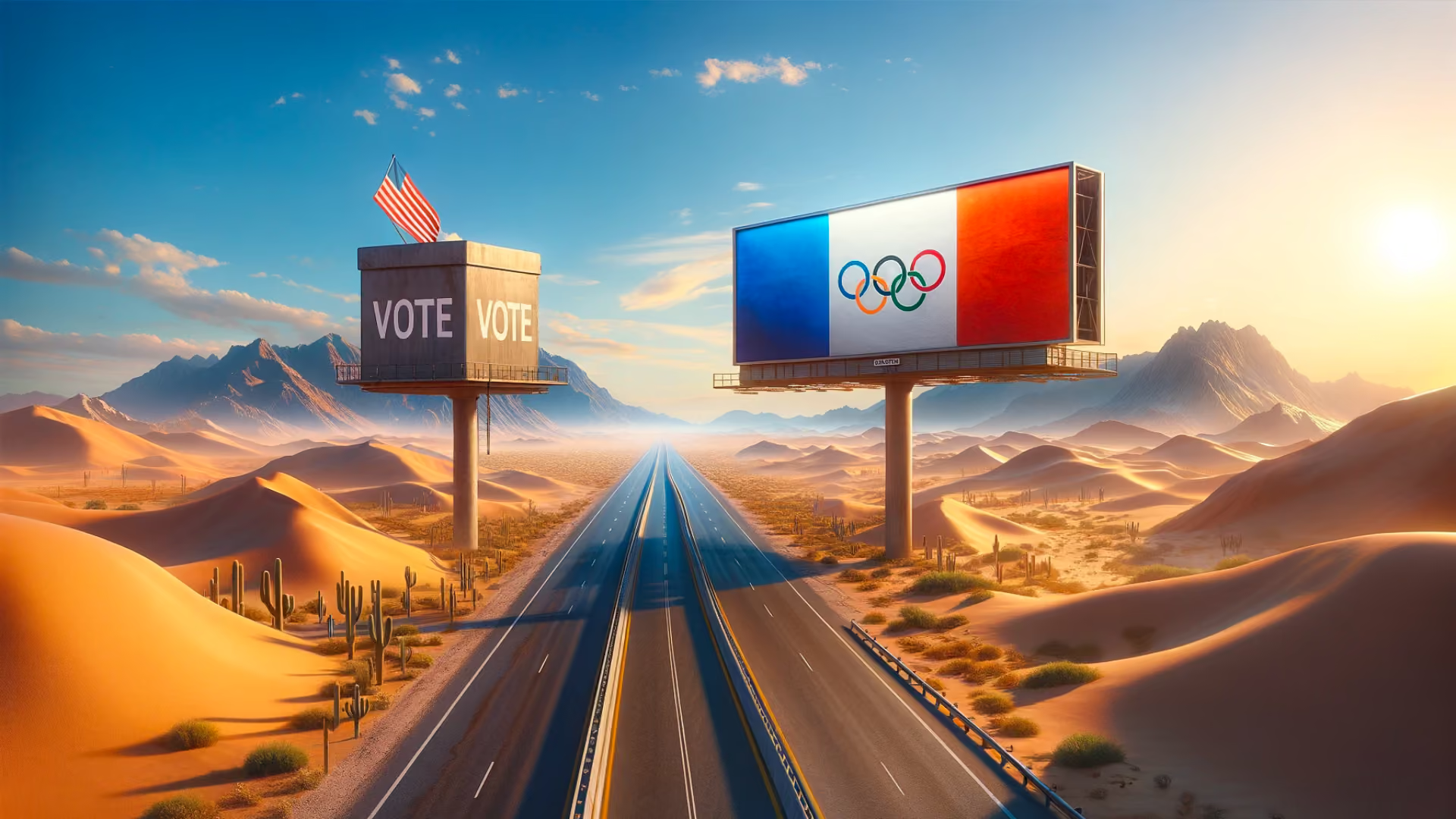
You don't need to be an economist or have a crystal ball to know that global attention is locked on two massively marketed events this year:
- The FIFA World Cup, hosted across the US, Mexico, and Canada, which is expected to drive an additional $10.5 billion in global ad spend in Q2 2026 alone : more than the entire global video game advertising market in a single quarter.
- The 2026 US midterms, on track to become the most expensive midterm cycle in history at a projected $11.6 billion in ad spend : 30% higher than the last midterm cycle.
So how does this affect how brands show up in 2026? It forces brands to take bigger creative risks, get sharper about where their AI investment actually goes, and pay real attention to the audience driving a disproportionate share of US economic growth.
In this article, we'll take you through how to capitalize on the moment and navigate the noise.
Key Takeaways:
- Creative risks will help you get the most out of your budget as World Cup and midterm campaigning eat up ad space and drive up costs.
- Third-party cookies didn't disappear the way the industry expected , but relying on them is still a shrinking strategy, and AI now touches far more of marketing than targeting alone.
- The Latino community is now the third-largest consumer market in the world; have a real plan for reaching them authentically.
Creativity will be an economic multiplier
It's hard to be hated, but easy to be ignored.
You might think today's cultural climate has made it difficult to take risks with your brand. But the reality is, you need to seriously mess up with your audience for them to bring down the axe.
Creative doesn't mean uninformed. Everything starts with knowing who you're talking to and who you are as a brand. Identify your audience and ask yourself what they like , and more importantly, what don't they like. Leverage demographic data and social listening to fully understand your customers.
But knowing your brand will ultimately guide your creativity. Create partnerships and unexpected offerings that speak to your brand and resonate with your audience.
Think of the Tums (yes, the indigestion tablets) and their Super Bowl partnership with DraftKings. You might think, "that's a weird pairing." But in reality, it makes perfect sense.
The Super Bowl is a foodie holiday: wings, pizza, and sliders galore. For those struggling with indigestion, Tums helps them enjoy the game instead of suffering the painful repercussions of extra spicy wings. DraftKings also wants to help people enjoy the game by enhancing their experience with betting. Tums and DraftKings stayed true to their brands while also getting creative with their partnership.
The importance of unapologetic creativity cannot be understated.
The sandbox you're comfortable playing in will shrink in 2026. With the World Cup and a record midterm cycle both competing for attention, digital and physical space will be congested with campaign activity, driving up CPMs across CTV and social. There won't be as much room for your brand out-of-home or online as there was even two years ago.
Enter: bold, unconventional ideas. Official FIFA partners like Adidas, Coca-Cola, and Visa have committed to their largest activations in history: Adidas alone had sold roughly $292 million in World Cup product before kickoff. But some of the sharpest plays are coming from brands that aren't official sponsors at all: Nike built a 12-week content universe around a single film rather than paying for official rights, and smaller brands are finding their own angles into the cultural moment without the sponsorship price tag.
Creativity will be your growth driver , your fuel to propel your business forward despite everything else happening in the world around you. It's the two elbows you use to make room in a crowded field.
AI has moved well past targeting — and the "death of the cookie" didn't happen the way everyone expected
Here's what didn't happen: Google did not eliminate third-party cookies in Chrome. After years of testing a phase-out, Google reversed course in 2024 and kept cookies on by default, with users able to opt out through browser settings. In October 2025, Google shut down most of the Privacy Sandbox APIs it had spent years building as the cookie's replacement.
That doesn't mean the old advice to diversify away from third-party data was wrong — it means the timeline was wrong. Cookie reliability has still eroded as more users opt into stricter privacy settings, and state-level privacy laws keep tightening what brands can do with third-party tracking regardless of what Chrome allows by default. Brands that spent the last two years building first-party data and contextual targeting capability are in a stronger position than brands that waited for a deadline that never came.
Meanwhile, AI's role in marketing has expanded well past audience targeting. Since 2024, generative AI has moved into content production, creative testing, and increasingly into agentic workflows that handle parts of a campaign end to end. The brands pulling ahead in 2026 aren't the ones that picked a single AI use case — they're the ones treating AI as infrastructure across strategy, content, and customer experience at once.
Agencies, in turn, are being called on to understand AI deeply enough to apply it where it actually moves outcomes, not just where it's easiest to bolt on. Brands need partners who can tell the difference.
The Latino consumer is now too large to treat as a niche
The US Latino consumer market has grown into one of the largest economies in the world in its own right. As of 2026, it's estimated at $2.8 trillion — the third-largest consumer market globally, trailing only a handful of national economies.
The numbers behind that scale:
- The US Latino population sits at roughly 63–68 million people, about 19–20% of the total US population, and Hispanics account for more than 70% of all US population growth.
- US Latinos accounted for 28.2% of total US economic growth in 2024, despite representing about a fifth of the population.
- By 2025, US Latinos accounted for 92.6% of all new US households formed, and continue to outpace the broader population in income growth, business formation, and consumer spending growth.
What does that mean for brands? It means this is no longer a "nice to have" segment — it's a core part of US consumer growth, and marketers need a real plan for how their brand shows up authentically within it.
The only way for brands to do this well is to invest in content that's genuinely relevant to Latino audiences, not a reskinned version of an existing campaign. This opportunity isn't exclusive to large brands with the resources to produce multilingual content — most US Latinos are US-born and English-proficient, so the work is less about translation and more about cultural fluency.
What it comes down to is whether your brand can honestly answer: how does my brand show up for Latino audiences? Are we part of their celebrations? Are we present at their events? Do we meet a real need, not just a demographic checkbox?
Latino culture and creators are more important than ever to impactful brand content. Brands that succeed here are the ones that invest directly in Latino creators and cultural moments rather than treating it as an add-on campaign. Consumers can tell if a brand is pandering or if it has a surface-level understanding of the culture it's speaking to.
Let's wrap this up
2026 has brands competing fiercely for visibility on platforms already packed with World Cup and midterm election activity. Marketers have real opportunity to drive creativity as a growth lever to compete with that noise. On AI, the lesson of the last two years is that the timeline for "the cookie is dead" was wrong, but the direction — first-party data, AI as infrastructure rather than a single tool — was right. And the Latino consumer market has grown too large and too fast for any brand serious about growth to treat it as a side strategy. As marketers, staying adaptable means updating the playbook when new information arrives, not defending predictions that didn't pan out.
Thanks for reading.
Frequently Asked Questions
Is this brand survival guide still relevant?The three trends it covers — creative risk-taking, AI-driven targeting replacing third-party cookies, and the growing influence of the Latino consumer — are ongoing shifts, not one-year predictions. The specific 2024 election and Olympics references are dated, but the underlying strategy still applies.
Why does creativity matter more when ad space gets competitive?When high-spend cycles (elections, major sporting events) drive up CPMs across digital and out-of-home, brands with a fixed budget get less reach for the same spend. Bold, well-targeted creative is what lets a brand stand out without simply outspending competitors for the same ad slots.
How has the end of third-party cookies changed brand targeting?Brands have shifted from demographic-based targeting using third-party cookies to contextual profiling and first-party data. Agencies and brands that understand how to build audiences this way are better positioned as the cookieless shift continues.
Why should brands pay attention to the Latino consumer?Latinos are the second-largest ethnic group in the US and a fast-growing share of consumer spending. Reaching this audience authentically doesn't require large multilingual campaigns — most US Latinos are English-proficient — but it does require brands to show up genuinely in the culture, not just translate existing campaigns.